Transformer Coupled Transistor Amplifier – Working Principle
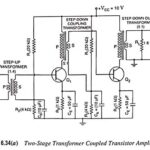
Transformer Coupled Transistor Amplifier - Working Principle: The main cause for low voltage and power gains of an R-C coupled amplifier is that the effective load (Rac) of each stage…
Step Response of an Amplifier: An alternative criterion of amplifier fidelity is the response of the amplifier to a particular input waveform. Of all possible available waveforms, the most generally…
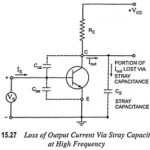
Effect of Internal Transistor Capacitance: As we know already that at high frequencies, the coupling and bypass capacitors act as short circuit due to their low reactance and hence the…
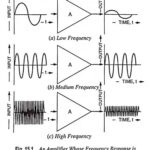
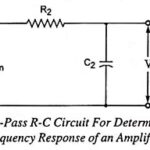
What is Frequency Response of an Amplifier? The voltage gain of an amplifier varies with signal frequency due to the effect of variations in circuit capacitive reactance with signal frequency…
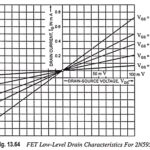
FET as a Voltage Variable Resistor (VVR): FET is a device that is usually operated in the constant-current portion of its output characteristics. But if it is operated in the…
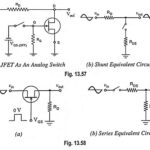
Applications of FETs (Field Effect Transistors): Applications of FETs - FET has a very high input impedance (100 MΩ in case of JFETs and 104 to 109 MΩ in case of…
What is Oscillator? - Types of Oscillators: An oscillator is the basic element of all ac signal sources and generates sinusoidal signals of known frequency and amplitude. It is one…
Facsimile (FAX) Machine - Definition, Operation and Applications: In addition to the basic signals consisting of speech, music, or telegraph codes, a telecommunications system is often required to transmit signals…