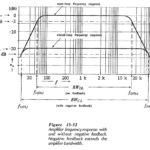
Effects of Negative Feedback in Amplifiers
Effects of Negative Feedback in Amplifiers: Decibels of Feedback - Effects of Negative Feedback in Amplifiers can be measured in decibels. A statement that 40 dB of feedback has been…
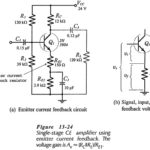
Emitter Current Feedback Circuit: Emitter Current Feedback Circuit is produced by connecting an unbypassed resistor in series with the emitter terminal of a transistor, as shown in Fig. 13-24(a). The…
Two Stage Direct Coupled BJT Amplifier Circuit: The Two Stage Direct Coupled BJT Amplifier Circuit in Fig. 13-17 is reproduced from Fig. 12-22, and modified to include feedback components RF1Â and…
Voltage Series Negative Feedback Amplifier: In a negative feedback amplifier, a small portion of the output voltage is fed back to the input. When the feedback voltage is applied in…
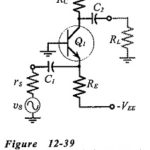
Capacitor Coupled Common Base Amplifier: A practical Capacitor Coupled Common Base Amplifier (using a plus/minus supply) is shown in Fig. 12-39. [Note the polarity of the input coupling capacitor (C1).]…
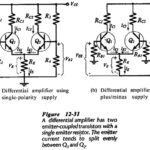
Differential Amplifier Circuit using Transistors: The Differential Amplifier Circuit using Transistors is widely applied in integrated circuitry, because it has both good bias stability and good voltage gain without the…
BIFET Amplifier: BJT-FET Considerations : Two-stage BJT circuits usually have relatively low input impedances. To increase Zi, a field effect transistor may be used as the first stage. Circuits which…
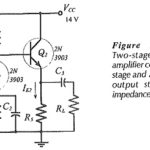
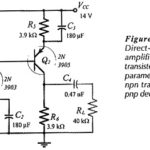
Two Stage Direct Coupled Common Emitter Amplifier: Figure 12-23 shows Two Stage Direct Coupled Common Emitter Amplifier. This time the second stage is a common collector circuit, or emitter follower.…