Operation of Synchronous Motor
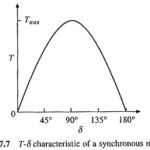
Operation of Synchronous Motor: Operation of Synchronous Motor - For any speed other than synchronous speed, the relative speed between air gap flux wave and the rotor is not zero.…
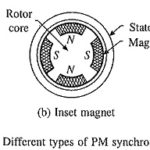
Synchronous Motors Types: Commonly used Synchronous Motors Types are: wound field, permanent magnet, synchronous reluctance and hysteresis motors. All these motors have a stator with a 3-phase winding, which is…
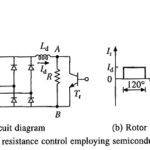
Rotor Resistance Control of Induction Motor: Speed-torque curves for Rotor Resistance Control of Induction Motor are given in Fig. 6.50. While maximum torque is independent of rotor resistance, speed at…
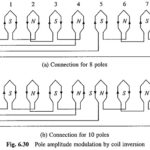
Pole Amplitude Modulation Induction Motor: Pole changing method as already discussed allows a change of speed by a factor 2. In some applications, speed change is required only by a…
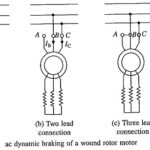
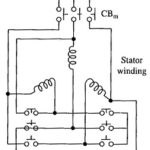
Dynamic Braking of Induction Motor(or Rheostatic Braking): (a) AC Dynamic Braking - AC Dynamic Braking of Induction Motor is obtained when the motor is run on a single phase supply…
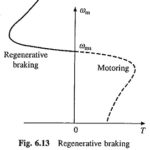
Braking of Induction Motor Drive: Following methods are employed for Braking of Induction Motor Drive: Regenerative braking Plugging or reverse voltage braking Dynamic (or rheostatic) braking further categorised as: ac…
Starting of Induction Motor Drives: Starting of Induction Motor Drives arrangement is chosen based on the load requirements and nature of supply (weak or stiff). It may be required to…
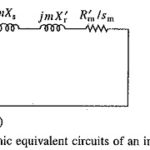
Harmonic Equivalent Circuit of Induction Motor: When fed from an inverter or cycloconverter, the motor terminal voltage is non-sinusoidal but it has half-wave symmetry. A non-sinusoidal waveform can be resolved…