Base Modulation Circuit Working Principle
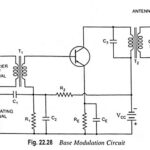
Base Modulation Circuit Working Principle: The circuit for base modulation is shown in Fig. 22.28. The carrier signal from a crystal oscillator is coupled to the base terminal of the…
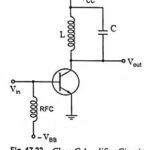
Class C Power Amplifiers - Circuit Diagram, Operation and Applications: A class C power amplifiers is biased to operate for less than 180° of the input signal cycle, as shown…
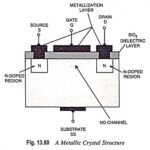
Enhancement Type MOSFET - Construction, Operation and Characteristics: Although DE-MOSFET is useful in special applications, it does not enjoy widespread use. However, it played an important role in history because…
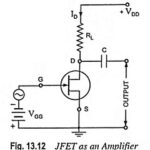
JFET as an Amplifier: One of the applications of JFET as an Amplifier of input signal. In FET the weak signal is applied between gate and source and an amplified…
JFET Temperature Effects: The JFET, like other solid state devices, is subject to the JFET Temperature Effects. However, it is possible to bias the JFET such that it will exhibit…
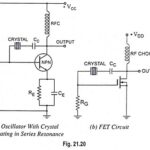
Crystal Oscillators - Circuit, Working, Advantages and Disadvantages: In crystal oscillators, the usual electrical resonant circuit is replaced by a mechanically vibrating crystal. The crystal (usually quartz) has a high…
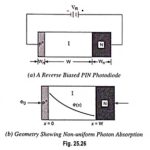
Pin Photodiode - Definition, Working and Applications: The PIN photodiode is one of the most common photodetectors, since the depletion-region thickness (intrinsic layer) can be tailored to optimize the quantum…
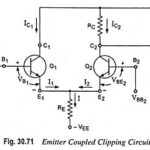
Emitter Coupled Clipper Circuit: An emitter coupled clipper using two transistors is shown in Fig. 30.71. It is a two level clipper in which the input is applied to the…