Class B Power Amplifier – Operation and Efficiency derivation
Class B Power Amplifier - Operation and Efficiency derivation: In Class B Power Amplifier operation, the transistor is so biased that zero signal collector current is zero. Hence class B…
Transformer Coupled Class A Power Amplifier: Transformer Coupled Class A Power Amplifier also sometimes referred to as single ended power amplifier. The term "single ended" (denoting only one transistor) is…
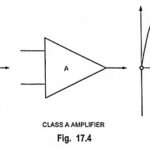
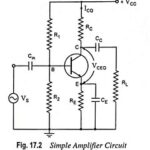
Class A Power Amplifiers (Direct Coupled with Resistive Load): A class A power amplifiers is defined as a power amplifier in which output current flows for the entire cycle (360°)…
Classification of Power Amplifiers: Classification of Power Amplifiers are primarily divided into two categories viz. audio power amplifiers and radio power amplifiers. Audio power amplifiers, also called the small signal…
Difference between Voltage Amplifier and Power Amplifier: The Difference between Voltage Amplifier and Power Amplifier are discussed below The primary function of the voltage amplifier is to raise the voltage…
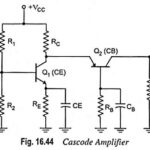
Cascode Amplifier or CE-CB Configuration: The CE-CB configuration (usually referred to as cascode amplifier) is shown in Fig. 16.44. Figure 16.44 shows a cascode configuration with a common-emitter (CE) stage…
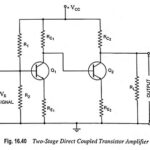
Direct Coupled Transistor Amplifier - Operations and Equivalent Circuit: Direct coupling is essential for very low frequency (below 10 Hz) applications such as photoelectric current, thermocouple current etc. Thermocouples are…
Transformer Coupled Transistor Amplifier - Working Principle: The main cause for low voltage and power gains of an R-C coupled amplifier is that the effective load (Rac) of each stage…