Skip to content
  • Electrical and Electronics Interview Questions and Answers
    • Electronics Engineering Interview Questions and Answers
    • Electrical Power Engineering Interview Questions and Answers
    • Communication Engineering Interview Questions and Answers
    • Digital Signal Processing Interview Questions and Answers
    • High Voltage Engineering Interview Questions and Answers
    • Microprocessor and Microcontroller Interview Questions and Answers
    • Protection and Switchgear Interview Questions and Answers
    • Power Electronics Interview Questions and Answers
    • Transmission and Distribution Interview Questions and Answers
    • Power System Operation and Control Interview Questions and Answers
    • READ MORE –>
  • Viva Questions and Answers
    • Electrical Engineering viva Questions and Answers
    • Electronics Communication Engineering viva Questions and Answers
  • Multiple Choice Questions with Answers
    • Electronics Engineering Multiple Choice Questions with Answers
    • Electrical Power Engineering Multiple Choice Questions with Answers
  • Comparisons in Electrical and Electronics
    • Difference between 80186 and 80286 Microprocessor
    • Difference Between Star and Delta Connections
    • Difference Between Electric Circuit and Magnetic Circuit
    • Difference between Static RAM and Dynamic RAM
    • Difference between Linear Power Supply and SMPS
    • Difference Between Thyristor and Transistor
    • Difference Between PAM, PWM and PPM
    • Difference between Isolator and Circuit Breaker
    • Difference between JFET and MOSFET
    • Difference between NMOS and PMOS
    • READ MORE –>
EEEGUIDE.COM
  • HOME
  • Electronics Engineering
  • Electronic Communication
  • Electronic Instrumentation
  • Electronic Devices and Circuits
  • Microprocessors and Microcontrollers
  • Electrical Power Engineering
  • Electrical Machines
  • High Voltage Engineering
  • Fundamentals of Electrical Drives
  • Circuits and Networks
  • Integrated Circuits
  • Network Analysis and Synthesis
  • Modern Power System
  • Principles of Power System
  • Power System Protection and Switchgear
  • Power Plant Engineering
Menu Close
Toggle the button to expand or collapse the Menu
  • Electronics Engineering
  • Electronic Communication
  • Electronic Instrumentation
  • Electronic Devices
  • Microprocessors and Microcontrollers
  • Electrical Power Engineering
  • Electrical Machines
  • Electrical Drives
  • High Voltage Engineering
  • Circuits and Networks
  • Integrated Circuits
  • Network Analysis and Synthesis
  • Modern Power System
  • Principles of Power System
  • Power System Protection and Switchgear
  • Power Plant Engineering
  • Interview Questions and Answers
  • Multiple Choice Questions with Answers
  • Comparisons in Electrical and Electronics
  • Viva Questions and Answers
Phase Splitter Circuit for Push Pull Power Amplifiers (or Phase Inverter)

Phase Splitter Circuit for Push Pull Power Amplifiers (or Phase Inverter)

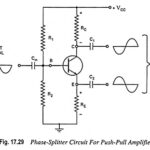
Phase Splitter Circuit for Push Pull Power Amplifiers (or Phase Inverter): In a push-pull amplifier circuit an input transformer is used to provide the polarity inversion between the two input…

Continue Reading Phase Splitter Circuit for Push Pull Power Amplifiers (or Phase Inverter)
Class AB Push Pull Amplifier – Circuit Diagram, Operation and Drawbacks

Class AB Push Pull Amplifier – Circuit Diagram, Operation and Drawbacks

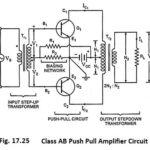
Class AB Push Pull Amplifier - Circuit Diagram, Operation and Drawbacks: The basic circuit of class AB push-pull amplifier is the same as that of class A push-pull amplifier shown…

Continue Reading Class AB Push Pull Amplifier – Circuit Diagram, Operation and Drawbacks
Class B Push Pull Amplifier – Circuit Diagram, Operation and Derivation

Class B Push Pull Amplifier – Circuit Diagram, Operation and Derivation

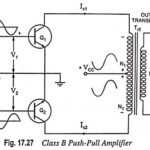
Class B Push Pull Amplifier - Circuit Diagram, Operation and Derivation: The circuitry for the Class B Push Pull Amplifier operation is the same as that for the class A…

Continue Reading Class B Push Pull Amplifier – Circuit Diagram, Operation and Derivation
Class A Push Pull Amplifier – Working Principle, Advantages & Disadvantages

Class A Push Pull Amplifier – Working Principle, Advantages & Disadvantages

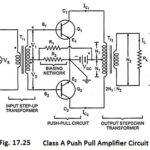
Class A Push Pull Amplifier - Working Principle, Advantages & Disadvantages: A Class A Push Pull Amplifier circuit is shown in Fig. 17.25. By Class A Push Pull Amplifier means…

Continue Reading Class A Push Pull Amplifier – Working Principle, Advantages & Disadvantages
Push Pull Amplifier – Circuit Diagram and its Workings

Push Pull Amplifier – Circuit Diagram and its Workings

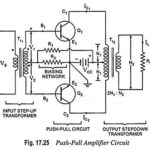
Push Pull Amplifier - Circuit Diagram and its Workings: As we know already that, double-ended or push pull amplifiers makes use of two identical transistors in a single stage. It consists of…

Continue Reading Push Pull Amplifier – Circuit Diagram and its Workings
Class D Power Amplifiers – Circuit Diagram, Operation and Applications

Class D Power Amplifiers – Circuit Diagram, Operation and Applications

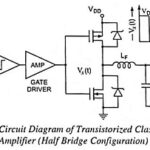
Class D Power Amplifiers - Circuit Diagram, Operation and Applications: Historically, audio amplifiers have been configured as class A, class B or class AB and the art of design is…

Continue Reading Class D Power Amplifiers – Circuit Diagram, Operation and Applications
Class AB Power Amplifier Working Principle

Class AB Power Amplifier Working Principle

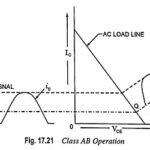
Class AB Power Amplifier Working Principle: In class AB power amplifier, the biasing circuit is so adjusted that the operating point Q lies near the cutoff voltage. During a small…

Continue Reading Class AB Power Amplifier Working Principle
Harmonic Distortion in Power Amplifier – Waveform and Derivation

Harmonic Distortion in Power Amplifier – Waveform and Derivation

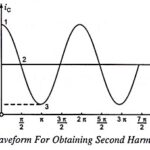
Harmonic Distortion in Power Amplifier - Waveform and Derivation: Harmonic Distortion in Power Amplifier - Output signal variations of less than 360° of the signal cycle are considered to have…

Continue Reading Harmonic Distortion in Power Amplifier – Waveform and Derivation
  • Go to the previous page
  • 1
  • …
  • 7
  • 8
  • 9
  • 10
  • 11
  • 12
  • 13
  • …
  • 56
  • Go to the next page

Popular Articles

  • Triangular Wave Generator Using Op amp
  • Single Phase Full Wave Controlled Rectifier
  • Square Wave Generator Using Op amp
  • BCD Adder Circuit
  • Class B Push Pull Amplifier
  • Second Order Low Pass Butterworth Filter
  • Voltage Series Feedback Amplifier
  • Intel 8051 Architecture and 8031 Architecture
  • Single Phase Fully Controlled Rectifier Control of DC Motor
  • Darlington Amplifier
  • Op Amp IC 741 Pin Diagram and its Working
  • IC 723 Voltage Regulator
  • Transient Response of RL Circuit
  • Load Frequency Control of Single Area System
  • Voltage Divider Bias Circuit
  • Voltage Shunt Feedback Amplifier Circuit
  • First Order Low Pass Butterworth Filter
  • Second Order High Pass Butterworth Filters
  • Internal Architecture of 8086
  • Precision Full Wave Rectifier

Recent Articles

  • Dual Input Balanced Output Differential Amplifier
  • What is Frequency Response of an Amplifier?
  • Direct Coupled Transistor Amplifier – Operations and Equivalent Circuit
  • FET Biasing Methods – Fixed Bias, Self Bias, Potential Divider Bias and Current Source Bias
  • Balanced Slope Detector – Working, Advantages and Disadvantages
  • What is MOSFET Resistor?
  • Types of Transistor Oscillators
  • Small Signal Model of MOSFET
  • Thyratron Working Principle
  • Methods of Sweep Voltage Generation
  • Inverter – Definition and Classification of Inverters
  • High Pass RC Circuit Diagram, Derivation and Application
  • Miller Sweep Circuit and Miller Bootstrap Sweep Circuit
  • What is Current Limiting Protection?
  • Advantages and Disadvantages of Digital Communication
  • Dual Gate MOSFET – N Channel Depletion Type MOSFET
  • Tuned Base Oscillator – Definition and Working Principle
  • Single Sideband Modulation (SSB)
  • AC Regulator – Definition and Classification
  • RC Coupled Transistor Amplifier – Operations, Derivation and Applications

Active users on site

  • HOME
  • PRIVACY POLICY
  • CONTACT US
  • SITEMAP
COPYRIGHT © 2014 TO 2026 EEEGUIDE.COM ALL RIGHTS RESERVED