Indirect Synthesizer
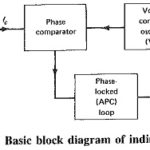
Indirect Synthesizer: Indirect Synthesizer: The required frequency range in most synthesizers nowadays is obtained from a variable voltage-controlled oscillator (VCO), whose output is corrected by comparison with that of a…
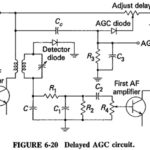
Delayed Automatic Gain Control: Delayed Automatic Gain Control: Simple AGC is clearly an improvement on no AGC at all, in that the gain of the receiver is reduced for strong…
Working Principle of Automatic Gain Control: Working Principle of Automatic Gain Control is a system by means of which the overall gain of a radio receiver is varied automatically with…
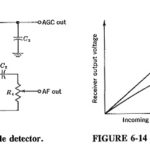
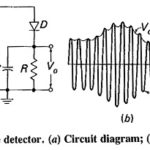
Simple Diode Detector: Operation of diode detector: The Simple Diode Detector is by far the most common device used for AM demodulation (or detection), and its operation will now be…
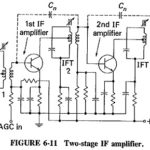
Intermediate Frequency Amplifier: Choice of frequency: The Intermediate Frequency Amplifier (IF) of a receiving system is usually a compromise, since there are reasons why it should be neither low nor…
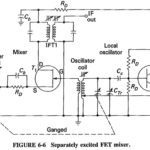
Frequency Changing and Tracking in Receivers: The mixer is a nonlinear device having two sets of input terminals and one set of output terminals. The signal from the antenna or…
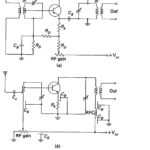
Transistor RF Amplifier Circuit: A radio receiver always has an RF section, which is a tunable circuit connected to the antenna terminals. It is there to select the wanted frequency…
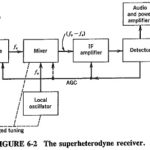
Superheterodyne Principle: The block diagram of Figure 6-2 shows a basic superheterodyne receiver. In the Superheterodyne Principle, the incoming signal voltage is combined with a signal generated in the receiver.…