Transistor Use in Static Relay
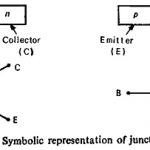
Transistor Use in Static Relay: Transistor Use in Static Relay - In its simplest form, it consists of two pn junction diodes coupled together by a very thin common base,…
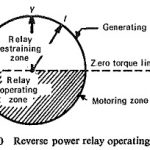
Prime Mover Protection: In the event of prime-mover failure the machine starts motoring meaning thereby that it draws electrical power from the system and drives the prime-mover. This condition imposes…
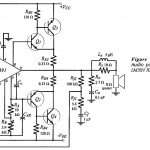
Audio Power Amplifier using IC Amplifier Driver: The LM391 integrated circuit Audio Power Amplifier using IC Amplifier Driver contains amplification and driver stages for controlling an externally-connected Class-AB output stage…
BJT Power Amplifier with Op Amp Driver: BJT Power Amplifier with Op Amp Driver Circuit Operation - The Class-AB power shown in Fig. 18-39 uses an operational amplifier (A1) for…
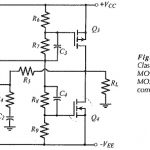
Complementary MOSFET Common Source Power Amplifier: Advantages of MOSFETs: Complementary MOSFET Common Source Power Amplifier have several advantages over power BJTs for large signal amplifier applications. One of the most…
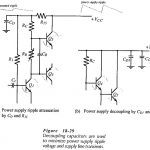
Power Supply Decoupling: Power Supply Decoupling - High-power amplifiers require high supply current levels, so unregulated power supplies are often employed to avoid the power wasted in a series regulator.…
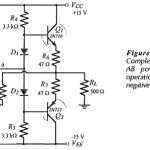
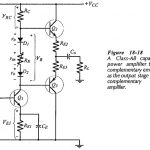
Capacitor Coupled Class AB Output Stage: The basic circuit of a Class-AB amplifier using a complementary emitter follower output stage and a Capacitor Coupled Class AB Output Stage load is…
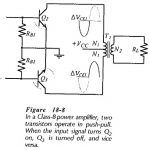
Transformer Coupled Class B Amplifier: Class B Amplifier - The inefficiency of Class-A amplifiers is largely due to the transistor bias conditions. In a Class-B amplifier, the transistors are biased…