Various Bias Compensation Methods
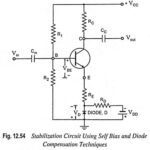
Various Bias Compensation Methods: During the discussion made for various biasing methods for providing stability to the operating point we have seen that self bias (or potential divider bias) and…
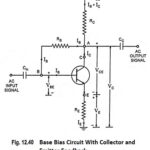
Base Bias Circuit With Collector and Emitter Feedback: In this Base Bias Circuit With Collector and Emitter Feedback circuit, as obvious from its name, both collector and emitter feedbacks are…
Base Bias with Collector Feedback Circuit: This Base Bias with Collector Feedback Circuit is like a fixed bias circuit except that the base resistor RB is returned to the collector…
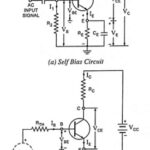
Self Bias or Potential Divider Bias Circuit: This is the most commonly used biasing arrangement. The arrangement of Self Bias or Potential Divider Bias Circuit is shown in Fig. 12.17…
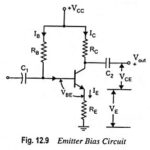
Emitter Bias Circuit Diagram: This Emitter Bias Circuit Diagram is obtained by simply introducing an emitter resistor to the fixed bias circuit as shown in Fig. 12.9. For analysis, we…
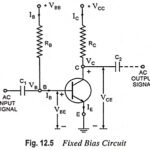
Fixed Bias Circuit Diagram - Advantages and Disadvantages: Fixed Bias Circuit Diagram shown in Fig. 12.5 uses two batteries VBB and VCC. The battery VBB gives potential to the base…
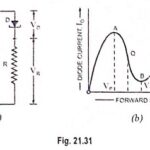
Negative Resistance Oscillators - Working and Types: Negative resistance oscillators make use of negative resistance elements such as tetrodes, tunnel diodes, unijunction transistors etc. There are two types of negative…
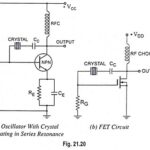
Crystal Oscillators - Circuit, Working, Advantages and Disadvantages: In crystal oscillators, the usual electrical resonant circuit is replaced by a mechanically vibrating crystal. The crystal (usually quartz) has a high…