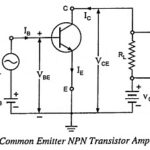
Transistor as an Amplifier – Circuit Diagram and Its Workings
Transistor as an Amplifier - Circuit Diagram and Its Workings: The main utility of a transistor lies in its ability of amplifying weak signals. The weak signal is applied at…
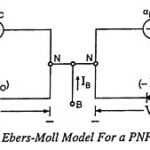
Ebers Moll Model for PNP Transistor: Device modelling aims at relating physical device parameters to device terminal characteristics. Device modelling is especially important for integrated circuits, since simple and accurate…
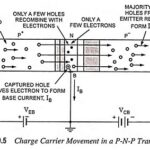
Important Points Regarding Working of Transistors: The noteworthy points regarding working of transistors are summarized below. 1. Current conduction in N-P-N transistor is by electrons and the conventional current flow…
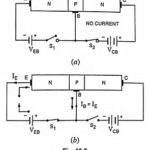
What is Transistor Biasing? - Types of Biasing As already mentioned, for normal operation of a transistor emitter-base junction is always forward biased and collector-base junction is always reverse biased.…
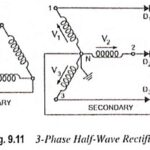
Three Phase Rectifiers: Three-Phase Half-Wave Rectifier : Figure 9.11 illustrates a circuit for a 3-phase half-wave rectifier. The three diodes are connected to the three phases of a 3-phase transformer…
What is Bleeder Resistor? - Working and Its Functions The operation of an inductor filter is based on the fact that a minimum current flows through it at all times.…
Baritt diode - Working and Applications: The barrier-inject transit time (BARITT) diode is basically a back-to-back pair of diodes biased into reach-through condition. It belongs to the transit-time microwave diode…
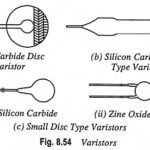
Varistors or Voltage Dependent Resistors (VDRS): Varistors, also called the voltage dependent resistors (VDRs), show a high degree of nonlinearity between their resistance value and the applied voltage. They are…