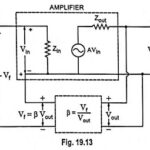
Effect of Negative Feedback on Output Impedance
Effect of Negative Feedback on Output Impedance: Just as high input impedance is advantageous to an amplifier, so is low output impedance. With lower output impedance, the amplifier is better…
Characteristics of Negative Feedback Amplifiers: The Characteristics of Negative Feedback Amplifiers are given below Stabilization of Gain With Negative Feedback: The variations in temperature, supply voltages, ageing of components or…
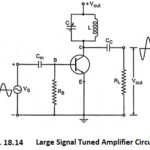
Large Signal Tuned Amplifier - Operation and its Equivalent Circuit: Tuned amplifier circuits are for class A operation and their use is limited to applications in which RF signal has…
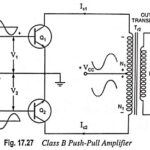
Class B Push Pull Amplifier - Circuit Diagram, Operation and Derivation: The circuitry for the Class B Push Pull Amplifier operation is the same as that for the class A…
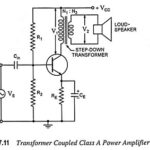
Transformer Coupled Class A Power Amplifier: Transformer Coupled Class A Power Amplifier also sometimes referred to as single ended power amplifier. The term "single ended" (denoting only one transistor) is…
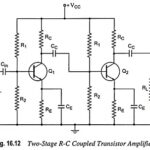
RC Coupled Transistor Amplifier - Operations, Derivation and Applications: A two-stage RC Coupled Transistor Amplifier using N-P-N transistors in CE configuration is shown in Fig. 16.12. The two transistors used are…
Phase Reversal in Single Stage Transistor Amplifier: In a common emitter configuration, the output voltage increases in the negative direction when the input signal increases in the positive direction and…
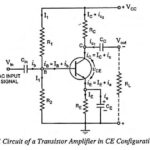
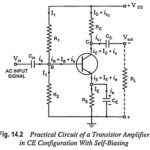
What is Single Stage Transistor Amplifier? - Circuit Diagram and its Workings When only one transistor with associated circuit is used for increasing the strength of a weak signal, the…