Skip to content
  • Electrical and Electronics Interview Questions and Answers
    • Electronics Engineering Interview Questions and Answers
    • Electrical Power Engineering Interview Questions and Answers
    • Communication Engineering Interview Questions and Answers
    • Digital Signal Processing Interview Questions and Answers
    • High Voltage Engineering Interview Questions and Answers
    • Microprocessor and Microcontroller Interview Questions and Answers
    • Protection and Switchgear Interview Questions and Answers
    • Power Electronics Interview Questions and Answers
    • Transmission and Distribution Interview Questions and Answers
    • Power System Operation and Control Interview Questions and Answers
    • READ MORE –>
  • Viva Questions and Answers
    • Electrical Engineering viva Questions and Answers
    • Electronics Communication Engineering viva Questions and Answers
  • Multiple Choice Questions with Answers
    • Electronics Engineering Multiple Choice Questions with Answers
    • Electrical Power Engineering Multiple Choice Questions with Answers
  • Comparisons in Electrical and Electronics
    • Difference between 80186 and 80286 Microprocessor
    • Difference Between Star and Delta Connections
    • Difference Between Electric Circuit and Magnetic Circuit
    • Difference between Static RAM and Dynamic RAM
    • Difference between Linear Power Supply and SMPS
    • Difference Between Thyristor and Transistor
    • Difference Between PAM, PWM and PPM
    • Difference between Isolator and Circuit Breaker
    • Difference between JFET and MOSFET
    • Difference between NMOS and PMOS
    • READ MORE –>
EEEGUIDE.COM
  • HOME
  • Electronics Engineering
  • Electronic Communication
  • Electronic Instrumentation
  • Electronic Devices and Circuits
  • Microprocessors and Microcontrollers
  • Electrical Power Engineering
  • Electrical Machines
  • High Voltage Engineering
  • Fundamentals of Electrical Drives
  • Circuits and Networks
  • Integrated Circuits
  • Network Analysis and Synthesis
  • Modern Power System
  • Principles of Power System
  • Power System Protection and Switchgear
  • Power Plant Engineering
Menu Close
Toggle the button to expand or collapse the Menu
  • Electronics Engineering
  • Electronic Communication
  • Electronic Instrumentation
  • Electronic Devices
  • Microprocessors and Microcontrollers
  • Electrical Power Engineering
  • Electrical Machines
  • Electrical Drives
  • High Voltage Engineering
  • Circuits and Networks
  • Integrated Circuits
  • Network Analysis and Synthesis
  • Modern Power System
  • Principles of Power System
  • Power System Protection and Switchgear
  • Power Plant Engineering
  • Interview Questions and Answers
  • Multiple Choice Questions with Answers
  • Comparisons in Electrical and Electronics
  • Viva Questions and Answers
Electron Beam Welding – Working Principle, Advantages, Disadvantages and Applications

Electron Beam Welding – Working Principle, Advantages, Disadvantages and Applications

Electron Beam Welding - Working Principle, Advantages, Disadvantages and Applications: Basically, electron beam welding in vacuum utilises the kinetic energy of electrons travelling with high velocity in a high vacuum…

Continue Reading Electron Beam Welding – Working Principle, Advantages, Disadvantages and Applications
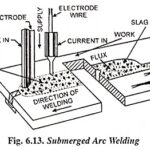
Submerged Arc Welding – Working, Advantages and Applications

Submerged Arc Welding – Working, Advantages and Applications

Submerged Arc Welding - Working, Advantages and Applications: Submerged Arc Welding - It is an arc welding process that uses an arc between a bare metal electrode and the weld…

Continue Reading Submerged Arc Welding – Working, Advantages and Applications
Carbon Arc Welding – Working Principle, Advantages and Applications

Carbon Arc Welding – Working Principle, Advantages and Applications

Carbon Arc Welding - Working Principle, Advantages and Applications: Carbon arc welding differs from metal arc welding in that it is a puddling process and is somewhat similar to the…

Continue Reading Carbon Arc Welding – Working Principle, Advantages and Applications
Projection Welding – Definition, Working, Advantages and Applications

Projection Welding – Definition, Working, Advantages and Applications

Projection Welding - Definition, Working, Advantages and Applications: Projection welding is a resistance welding process that produces coalescence by the heat obtained from the resistance to the flow of the…

Continue Reading Projection Welding – Definition, Working, Advantages and Applications

What is Welding Process? – Definition and Classification

What is Welding Process? - Definition, Classification, Advantages and Disadvantages: Welding Process is a materials joining that produces coalescence of materials by heating them to the welding temperature with or…

Continue Reading What is Welding Process? – Definition and Classification
Heating of Buildings – Factors and Types

Heating of Buildings – Factors and Types

Heating of Buildings - Factors and Types: The purpose of most forms of space-heating installation is to provide comfortable conditions in which people can work or relax. Space heating of…

Continue Reading Heating of Buildings – Factors and Types

Electronics Engineering Multiple Choice Questions and Answers (MCQs) Part 9

Electronics Engineering Multiple Choice Questions and Answers (MCQs) Part 9: 343. When an 8086 executes an INT type instruction, it (a) resets both IF and TF flags. (b) resets all…

Continue Reading Electronics Engineering Multiple Choice Questions and Answers (MCQs) Part 9

Electronics Engineering Multiple Choice Questions and Answers (MCQs) Part 3

Electronics Engineering Multiple Choice Questions and Answers (MCQs) Part 3: 106. Which of the transistor models is most preferred for the analysis of a transistor circuit both at mid-band and…

Continue Reading Electronics Engineering Multiple Choice Questions and Answers (MCQs) Part 3
  • Go to the previous page
  • 1
  • …
  • 44
  • 45
  • 46
  • 47
  • 48
  • 49
  • 50
  • …
  • 110
  • Go to the next page

Popular Articles

  • Triangular Wave Generator Using Op amp
  • Single Phase Full Wave Controlled Rectifier
  • Square Wave Generator Using Op amp
  • BCD Adder Circuit
  • Class B Push Pull Amplifier
  • Second Order Low Pass Butterworth Filter
  • Voltage Series Feedback Amplifier
  • Intel 8051 Architecture and 8031 Architecture
  • Single Phase Fully Controlled Rectifier Control of DC Motor
  • Darlington Amplifier
  • Op Amp IC 741 Pin Diagram and its Working
  • IC 723 Voltage Regulator
  • Transient Response of RL Circuit
  • Load Frequency Control of Single Area System
  • Voltage Divider Bias Circuit
  • Voltage Shunt Feedback Amplifier Circuit
  • First Order Low Pass Butterworth Filter
  • Second Order High Pass Butterworth Filters
  • Internal Architecture of 8086
  • Precision Full Wave Rectifier

Recent Articles

  • Class AB Push Pull Amplifier – Circuit Diagram, Operation and Drawbacks
  • Voltage to Current Converter Circuit
  • Current to Voltage Converter Circuit
  • Linear Diode Detector or Envelope Detector
  • What is Resistor Transistor Logic (RTL) Circuit?
  • How to use a Transistor as a Diode – Working and Equation
  • Voltage Controlled Voltage Source (VCVS) Circuit
  • Classification of Gas Filled Tubes
  • Quantitative Theory of PN Junction Diode
  • Class D Power Amplifiers – Circuit Diagram, Operation and Applications
  • Advantages and Disadvantages of Digital Communication
  • What is Waveshaping? – Types
  • Miller Effect in Amplifier Frequency Response
  • Common Drain JFET Amplifier or Source Follower
  • Double Differentiation – Derivation
  • Transistor Construction
  • Varistors or Voltage Dependent Resistors (VDRS)
  • Inverter – Definition and Classification of Inverters
  • Transistor approximation (Ideal, Second and Higher)
  • Multivibrator definition and Types (Astable, Monostable and Bistable)

Active users on site

  • HOME
  • PRIVACY POLICY
  • CONTACT US
  • SITEMAP
COPYRIGHT © 2014 TO 2026 EEEGUIDE.COM ALL RIGHTS RESERVED