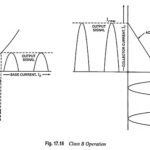
Class B Power Amplifier – Operation and Efficiency derivation
Class B Power Amplifier - Operation and Efficiency derivation: In Class B Power Amplifier operation, the transistor is so biased that zero signal collector current is zero. Hence class B…
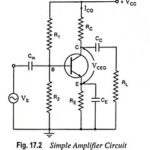
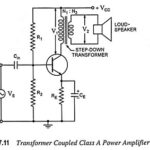
Transformer Coupled Class A Power Amplifier: Transformer Coupled Class A Power Amplifier also sometimes referred to as single ended power amplifier. The term "single ended" (denoting only one transistor) is…
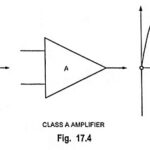
Class A Power Amplifiers (Direct Coupled with Resistive Load): A class A power amplifiers is defined as a power amplifier in which output current flows for the entire cycle (360°)…
Classification of Power Amplifiers: Classification of Power Amplifiers are primarily divided into two categories viz. audio power amplifiers and radio power amplifiers. Audio power amplifiers, also called the small signal…
Difference between Voltage Amplifier and Power Amplifier: The Difference between Voltage Amplifier and Power Amplifier are discussed below The primary function of the voltage amplifier is to raise the voltage…
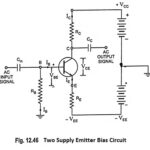
Two Supply Emitter Bias Circuit: From the stability point of view, this two supply emitter bias circuit is the best of all already discussed circuits, but it has one drawback…
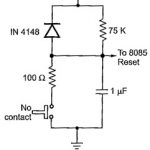
Power on Reset Circuit in 8051: On reset, the PC sets to 0000H which causes the 8085 to execute the first instruction from address 0000H. For proper reset operation reset…
Apparatus Protection in Power System Articles: Transformer Protection Types: Nature of Transformer Faults: Power transformers, being static, totally enclosed and oil immersed develop faults only rarely but the consequences of…