Complementary Symmetry Push Pull Amplifier
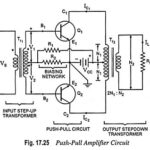
Complementary Symmetry Push Pull Amplifier: The use of transformers, at input as well as at output ends, in the push-pull amplifier shown in Fig. 17.25 makes it bulky and expensive…
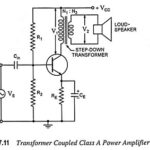
Transformer Coupled Class A Power Amplifier: Transformer Coupled Class A Power Amplifier also sometimes referred to as single ended power amplifier. The term "single ended" (denoting only one transistor) is…
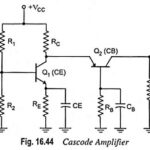
Cascode Amplifier or CE-CB Configuration: The CE-CB configuration (usually referred to as cascode amplifier) is shown in Fig. 16.44. Figure 16.44 shows a cascode configuration with a common-emitter (CE) stage…
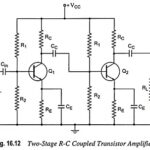
RC Coupled Transistor Amplifier - Operations, Derivation and Applications: A two-stage RC Coupled Transistor Amplifier using N-P-N transistors in CE configuration is shown in Fig. 16.12. The two transistors used are…
Miller Effect in Amplifier Frequency Response: According to this effect, when viewed from the input base terminal of the CE-connected transistor the capacitance Ccb appears as (1 - Av)Ccb i.e., it is…
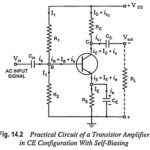
What is Single Stage Transistor Amplifier? - Circuit Diagram and its Workings When only one transistor with associated circuit is used for increasing the strength of a weak signal, the…
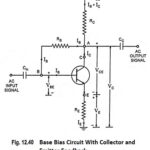
Base Bias with Collector Feedback Circuit: This Base Bias with Collector Feedback Circuit is like a fixed bias circuit except that the base resistor RB is returned to the collector…
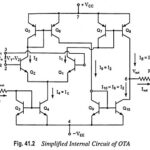
Operational Transconductance Amplifier (OTA): The operational amplifiers considered up to this point have been voltage amplifiers. The input signal is a voltage and the output signal is a voltage. Another…