Liquid Dielectrics
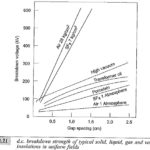
Liquid Dielectrics Breakdown: Liquid dielectrics, because of their inherent properties, appear as though they would be more useful as insulating materials than either solids or gases. This is because both…
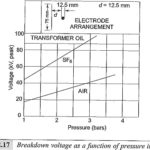
Gases and Gas Mixtures for Insulation Purposes: Over the years, considerable amount of work has been done to adopt a specific gas for practical use. Before adopting a particular gas…
Breakdown in Non Uniform Fields: In Breakdown in Non Uniform Fields, such as coaxial cylinders, point-plane and sphere-plane gaps, the applied field varies across the gap. Similarly, Townsend's first ionization…
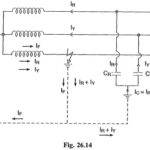
Resistance Grounding: In order to limit the magnitude of earth fault current, it is a common practice to connect the neutral point of a 3-phase system to earth through a…
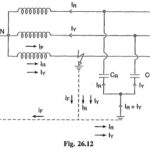
Solid Grounding or Effective Grounding: When the neutral point of a 3-phase system (e.g. 3-phase generator, 3-phase transformer etc.) is directly connected to earth (i.e. soil) through a wire of…
System Grounding: The process of connecting some electrical part of the power system (e.g. neutral point of a star-connected system, one conductor of the secondary of a transformer etc.) to…
Grounding or Earthing: The process of connecting the metallic frame (i.e. non-current carrying part) of electrical equipment or some electrical part of the system (e.g. neutral point in a star-connected…
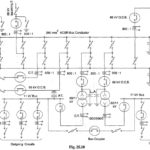
Key Diagram of Substation 66/11KV: Fig. 25.10 shows the key diagram of a typical 66/11 kV sub-station. The Key Diagram of Substation can be explained as under: 1. There are…