Complementary Symmetry Push Pull Amplifier
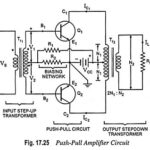
Complementary Symmetry Push Pull Amplifier: The use of transformers, at input as well as at output ends, in the push-pull amplifier shown in Fig. 17.25 makes it bulky and expensive…
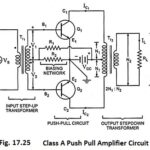
Class A Push Pull Amplifier - Working Principle, Advantages & Disadvantages: A Class A Push Pull Amplifier circuit is shown in Fig. 17.25. By Class A Push Pull Amplifier means…
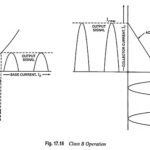
Class B Power Amplifier - Operation and Efficiency derivation: In Class B Power Amplifier operation, the transistor is so biased that zero signal collector current is zero. Hence class B…
What is Oscillator? - Types of Oscillators: An oscillator is the basic element of all ac signal sources and generates sinusoidal signals of known frequency and amplitude. It is one…
DC Motor Drives Articles: Types of DC Motor: The commonly used Types of DC Motor are shown in Fig. 5.1. In a separately excited motor, the field and armature voltages…
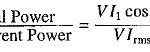
Power Factor Improvement Methods: There are many drives which operate at a low power factor. Some of Power Factor Improvement Methods are: An induction motor direct on line. ac-dc diode…
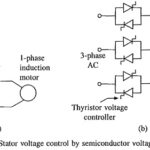
Stator Voltage Control of Induction Motor: By reducing Stator Voltage Control of Induction Motor, speed of a high-slip induction motor can be reduced by an amount which is sufficient for…
Drawbacks of Rectifier Fed DC Drives: Drawbacks of Rectifier Fed DC Drives are as follows: 1. Distortion of Supply: Source current of a rectifier has harmonics. In a weak ac…