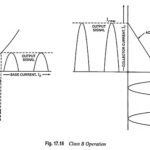
Class B Power Amplifier – Operation and Efficiency derivation
Class B Power Amplifier - Operation and Efficiency derivation: In Class B Power Amplifier operation, the transistor is so biased that zero signal collector current is zero. Hence class B…
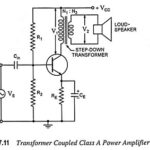
Transformer Coupled Class A Power Amplifier: Transformer Coupled Class A Power Amplifier also sometimes referred to as single ended power amplifier. The term "single ended" (denoting only one transistor) is…
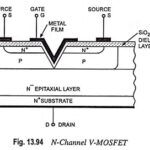
N Channel Power MOSFETs or V-MOSFET or V-FET: N Channel Power MOSFETs - Power MOSFETs are usually constructed in V-configuration, as shown in Fig. 13.94. That is why, the device is…
Bias Stability Factor of Transistor: Bias Stability Factor of Transistor - Only the fixing of a suitable operating point is not sufficient but it is also to be ensured that…
Characteristics of Regulated Power Supply: The quality of power supply depends on different factors such as its load voltage, load current, voltage regulation, source regulation, output impedance, ripple rejection etc.…
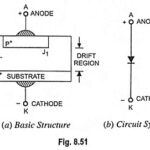
Power Diode - Structure, Symbol, Characteristics and Types: Diodes find many applications in electronics and electrical engiÂneering circuits. Power diodes play a significant role in power electronics for conversion of…
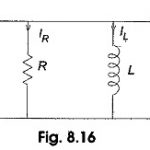
Quality Factor of Parallel RLC Circuit: Consider the Quality Factor of Parallel RLC Circuit shown in Fig. 8.16. In the circuit shown, the condition for resonance occurs when the susceptance…
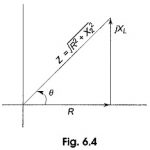
Reactive Power and The Power Triangle: We know that the average power dissipated is From the impedance triangle shown in Fig. 6.4 If we substitute Eqs (6.12) and (6.13) in…